The Problem: You’re not imagining it — your pain cream just isn’t built to reach the source
If you’ve got arthritis, you already know the ritual. You wake up, and before you’ve even swung your legs out of bed, your knees or your hands tell you what kind of day it’s going to be. Stiff. Tight. Sometimes locked up entirely until you’ve walked it off.
So you reach for the cream. The one from the pharmacy aisle with the ice-blue label and the word “MAX STRENGTH” in bold letters. You rub it in. You feel a cooling tingle. And twenty minutes later — nothing. The ache is still there, underneath the menthol, waiting.
This isn’t a willpower problem, or a “some people just respond differently” problem. It’s a mechanism problem. Most over-the-counter joint creams are built around a single trick: counter-irritation. Menthol or camphor triggers cold receptors in your skin, and your brain gets briefly distracted by that sensation instead of the pain signal underneath. It’s real, but it’s shallow — a decoy, not a blockade. It does nothing to the actual nerve endings firing pain signals from the joint, and nothing to the inflammatory chemistry causing the swelling in the first place.
The cost of settling for distraction instead of relief
Here’s what actually happens when your pain relief is a decoy instead of a solution. You start avoiding things. The walk you used to take every morning gets shorter, then optional, then gone. Gardening becomes something you watch other people do. You catch yourself gripping the stair rail with both hands instead of one. None of this happens dramatically — it happens by inches, as your body quietly recalibrates around pain it hasn’t been able to shake.
Meanwhile, the alternatives on the table aren’t much better. Oral NSAIDs like ibuprofen work on inflammation, but taken daily over months or years they carry real risk to your stomach lining, kidneys, and cardiovascular system — risk that compounds specifically in the population that needs joint relief the most: people over 60. Opioid-adjacent options carry their own well-documented dangers. And injections mean needles, appointments, and copays, for relief that’s often temporary and localized to a single joint.
So you’re left choosing between a cream that distracts for twenty minutes, a pill that quietly wears on your organs, or a needle. That’s not a real choice. That’s just picking which trade-off bothers you least — and it’s exactly why so many people with chronic joint pain simply stop looking for relief and start living with less.
The Solution: a topical built on three mechanisms, not one
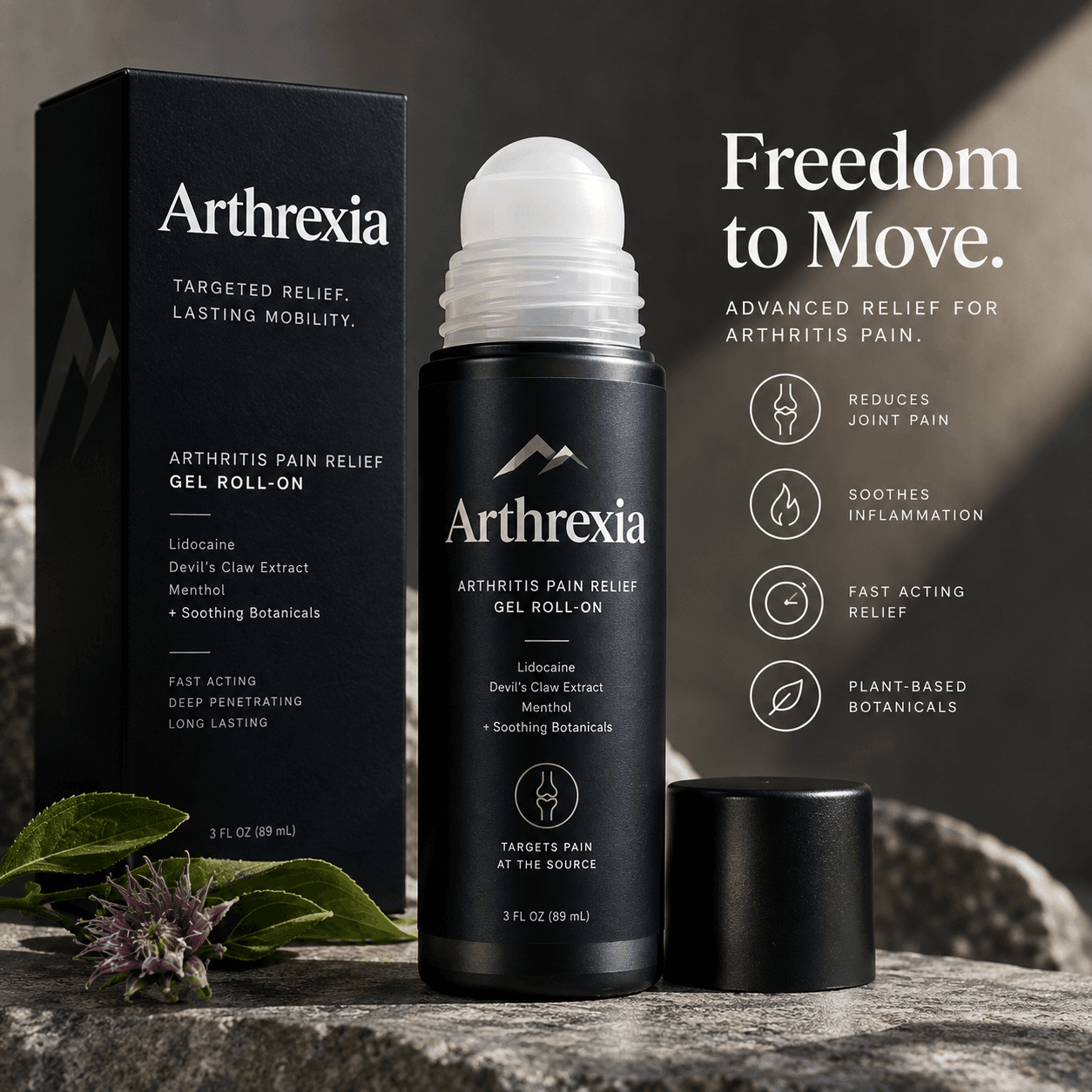
This is the gap we built our formula to close. Instead of relying on a single counter-irritant trick, our topical stacks three distinct, complementary mechanisms of action — targeting the nerve signal, the inflammation, and the sensory competition, all at once, all from a single application.
Mechanism 01
Lidocaine
Blocking the pain signal at the source.
Lidocaine isn’t a sensation or a distraction. It’s a sodium channel blocker. Pain signals travel from your joint to your brain via electrical impulses moving along nerve fibers, and those impulses depend on sodium ions rushing through voltage-gated channels — specifically Nav1.7 and Nav1.8 channels, which are heavily concentrated in the peripheral nerves responsible for transmitting pain. Lidocaine physically binds to these channels and prevents them from opening. No sodium influx, no depolarization, no signal.
It’s the same class of mechanism used in medical-grade local anesthesia — here, delivered at an OTC-appropriate concentration, directly to the nerve endings just beneath the skin over the joint. This is why lidocaine produces genuine numbing rather than a masking sensation: it’s interrupting the electrical conversation between your joint and your brain, not just adding a louder one on top of it.
Mechanism 02
Devil’s Claw
Working the inflammation, not just the pain.
Devil’s claw (Harpagophytum procumbens) has a long history in traditional use for joint discomfort, and modern research has started to explain why: its primary active compound, harpagoside, appears to interfere with the inflammatory cascade — specifically by inhibiting COX-2 activity and downregulating pro-inflammatory cytokines like TNF-alpha, the same general pathway that NSAIDs target, but through a plant-derived iridoid glycoside rather than a synthetic compound.
Why the stack matters more than any single ingredient
Any one of these three mechanisms alone is a modest product. Lidocaine by itself numbs, but doesn’t touch inflammation. Devil’s claw by itself reduces inflammation, but does nothing for the nerve signal already firing. Menthol by itself is a distraction that wears off in minutes. What makes this formula different isn’t a rare or exotic ingredient — it’s that it engages the nerve, the tissue, and the sensory system simultaneously, so that when one mechanism’s effect starts to taper, the other two are still working.
That’s the actual definition of relief that holds up past the first twenty minutes: not a single strong hit, but three independent systems working the problem from different angles, so the pain doesn’t have a gap to slip back through.
The bottom line
You don’t need another cream that trades one sensation for another. You need something that actually interrupts the signal, addresses the inflammation causing it, and only then adds the sensory layer on top — instead of leaning on that layer to do all the work. That’s the difference between a product built around a marketing claim and one built around how pain actually travels through your body.
Try Arthrexia